 This second part of my two Yunnan Baiyao articles — and a closer look than my posts on holistic medicine, in general.
⏰🥱👉 TL;DR (for the sleep-deprived and Google-weary)
That mysterious tiny red capsule tucked into every box of Yunnan Baiyao? It’s not a daily supplement, a bonus vitamin, or a secret superpower. It’s an emergency pill — meant only for serious, active bleeding or shock, and only when your vet tells you to give it. Too much, too often, or given prophylactically as a preventative measure can actually make things worse. It’s like keeping a fire extinguisher under your sink: comforting to have, but definitely not something you play with.
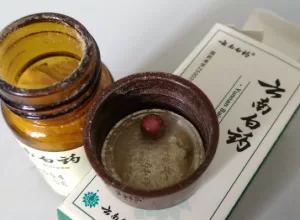
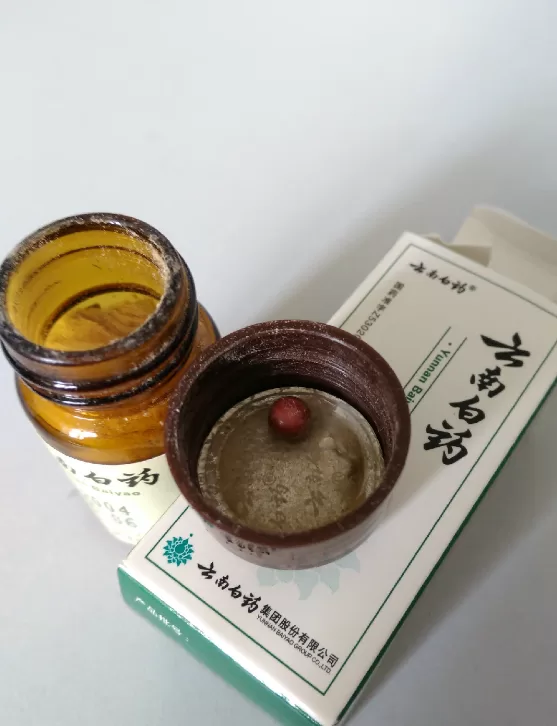
What Is This Red Pill in the Center of the Packet?
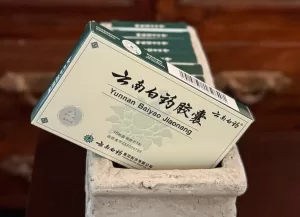
Every box of Yunnan Baiyao (or YB, for short) comes with one tiny, shiny red capsule that looks like it needs to be accompanied by its own melodramatic soundtrack. Spoiler alert: It’s concentrated Yunnan Baiyao. And meant for emergencies only.
In traditional Chinese medicine, this “safety pill” (often called Bao Xian Zi) is the heavy hitter, reserved for life-threatening bleeding. Think: your dog collapses, gums go white, abdomen distends — you’re definitely going to the ER, and your vet has specifically described this as, “This is the time.” That’s the red pill’s moment to do its job.
Why Vets Tell You to Save It for Emergencies
Because it is believed to works by stimulating clotting and circulation, the red pill can potentially make things worse if given at the wrong time.
Giving it too early or too often could:
Mask symptoms that tell your vet what’s actually happening — or it could potentially delay real emergency care, allowing you to think you’ve fixed the problem
Cause unwanted clotting in dogs at risk for stroke or embolism
- Stress the liver
Mess with other meds that affect bleeding and blood pressure
In other words: it’s strong, but not smart. It can’t tell the difference between “stopping a bleed” and “starting trouble.” If a bleed suspected, it’s always better to call your vet or the ER first and use the red pill only if they say so.
Think of it as a panic button, not a daily vitamin. Once you hit it, you want trained help on the way.
So, Should You Even Keep Them?
Yes, the vets say: keep a few newer ones on hand. It can absolutely save a life in the right scenario. Just store it like you would your emergency flashlight: somewhere you can find it and somewhere your dog can’t. And make sure any adult in your household knows what it’s for, why, and when.
In our case, because we take Cat along with us just about anywhere dogs are welcome, I also carry one in my purse (along with 2 Yunnan Baiyao capsules — prescribed for her weight — which her vet said to administer in emergencies — all in a special tiny labeled bottle stuffed with “pill cotton”).
Our Experience with the Red Pills
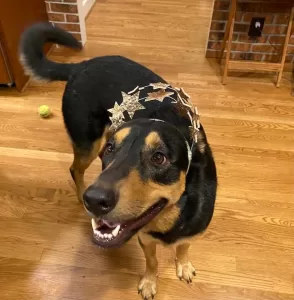
As I typically preface: This not medical advice; it’s just our own story. I have administered the red pill 3 times over 8+ months.
Red Pill 1: Was admittedly an overreaction: It was early on, and she was very lethargic when she woke up. I panicked — crammed the red pill + 2 YB capsules down her throat — and was running around the house throwing stuff into a bag, preparing to whisk her off to the ER. Then, she asked for breakfast, promptly ate it, and was suddenly fine.
Red Pill 2: It was a similar scenario, except that she wasn’t bouncing back. Her gums were — I wasn’t sure — maybe pale-ish? I remember googling “what do dog pale gums look like?” That didn’t help much. It was mostly pulling pics from Reddit with other dog-parents asking the same thing. Unable to decide, we felt she should see a vet. Problem was: We were on an island off NC, and it was a Sunday, so no vet clinics were open — and the closest ER was over an hour away. We decided to quickly pack up, leave, and take her to NC State — 2+ hours away, but we knew she’d be in good hands (it also happens to be on the way home). By the time we got to Raleigh, she wasn’t 100% but had improved, so we decided against the ER. She continued improving throughout the day and was pretty much fine by the following morning.
Red Pill 3: Again, lethargic. Again, the jury was still out on what pale gums look like. This time we were home and did take her to the ER. She only had a point-of-care ultrasound which we were told will not always show smaller bleeds. After giving her IV fluids, they monitored her for a few hours and decided there was nothing bad enough to warrant comprehensive diagnostics. We took her home and all was fine following that episode.
…So the gist, here, is: Has the little red pill worked for Cat? I can’t say for sure — but maybe that’s the more important point — I don’t know because she’s still with us, so what I do know is that it hasn’t failed her. I’ll take that to the bank, for now.
Another Reason We Keep the Little Red Pills
In short: symbolism.
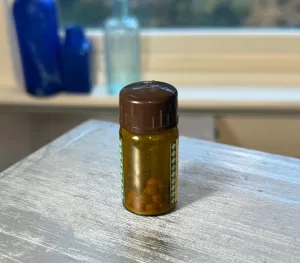
I keep the new ones in a safe place, but retire the older ones to their own little jar. …Because now seeing a ton of little red pills in that container shows us just how far we’ve come. The more there are means the longer Cat has made it.
How Best to Prepare
Ask your vet to write down exactly when and how to use it.
Tape those instructions to the box. (Because in a panic, you won’t remember.)
Check the expiration date — they do go bad.
If you ever have to use it and did not actually go to the ER, tell your vet afterward — even if your dog seems fine.
Bottom Line
The little red pill is not a supplement — it’s an emergency tool. Used correctly, it can buy precious time. Used incorrectly, it can cause more harm than good. So tuck it away, label it clearly, and resist the temptation to experiment.
And honestly, if you ever feel like you’re overthinking it, remember: there’s a whole (unfortunate) “club” of us who have stood in the kitchen holding that tiny red capsule, wondering if we’re about to perform ancient Eastern Medicine magic or make a mistake. You’re not alone. You’re just a dog parent who loves too hard — and reads too much.
 Carrie Stewart is a journalist and award-winning TV producer-turned-advocate for canine cancer awareness after working night and day for months on end to help her German Shepherd foster-fail/rescue pup, Cat the Dog, head off hemangiosarcoma for as long as she possibly can.